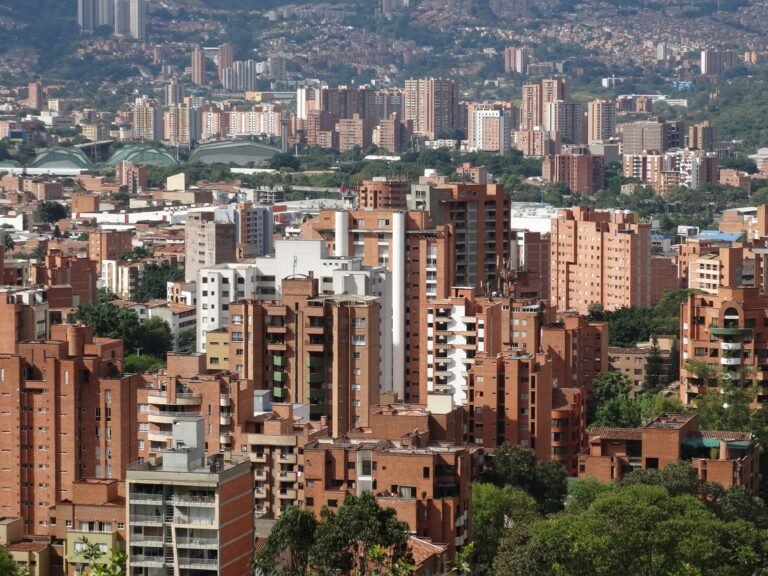
There is something that happens on the tree-lined streets of Laureles that explains, without words, why Time Out ranked it among the world’s best neighborhoods for digital nomads. It is a rhythm. A rhythm that does not feel like El Poblado —more polished, more touristy— nor like downtown —more chaotic, louder. Laureles is a middle point that only Medellín knows how to produce: calm, walkable, authentic, and, increasingly, connected to the rest of the world.
If you are reading this, you probably already know that Medellín is one of the most attractive cities on the planet for remote work. Perfect weather year-round, reasonable cost of living, modern infrastructure, a huge nomad community, and direct flights from the United States and Europe. The question is no longer whether to come. The question is where to stay. And this guide answers exactly that.
We are writing from Laureles. We are Carolina and Leonardo, two Colombian remote workers who spent five years traveling the world as digital nomads before opening Pranik — a wellness coliving at the heart of this neighborhood. Here is what we have learned: what makes Laureles special, where to work, where to live, what to do, and how to get around.
Why Laureles is the ideal neighborhood for digital nomads in 2026
Laureles sits in the western part of Medellín, about fifteen minutes from the regional Olaya Herrera airport and thirty-five minutes from the José María Córdova international airport. It was designed in the 1940s under an urban concept that was rare in Latin America at the time: circular streets around the Atanasio Girardot stadium, tree-lined avenues, mid-rise buildings, and a human-centric —not vehicle-centric— density that makes the neighborhood walk better than it drives.
That architectural decision, made eighty years ago, is why Laureles consistently ranks among the most beloved neighborhoods for nomads today. Unlike El Poblado, where steep hills and traffic force you to rely on Uber and taxis, in Laureles you can live entire weeks on foot. Bakery around the corner. Specialty coffee three blocks away. Gym, grocery store, pharmacy, post office — all within a ten-minute walk.
Add to that: Medellín has the best fiber-optic infrastructure in Colombia, with residential speeds averaging above 300 Mbps. Laureles, being a consolidated neighborhood, has mature, stable wiring. The climate hovers around 22°C year-round — no heating, no air conditioning needed. And the local nomad community, already robust in El Poblado, has begun migrating to Laureles looking for less tourism and more neighborhood. It is the natural choice for conscious travel and slow travel in Colombia.
“Laureles is not the place you go to feel like a foreigner surrounded by other foreigners. It is the place you go to live in Medellín.”
The neighborhood by the numbers
- Altitude: 1,495 meters above sea level
- Average temperature: 22°C year-round
- Walkability: high (grid plus concentric-circle street layout)
- Safety: one of the best-perceived comunas in Medellín
- Average residential internet speed: 300+ Mbps
- Specialty coffee shops in Laureles and Estadio: 40+
- Distance to Atanasio Girardot Stadium and its metro station: 5-10 minutes walking
Where to work: the best cafés and coworking spaces in Laureles
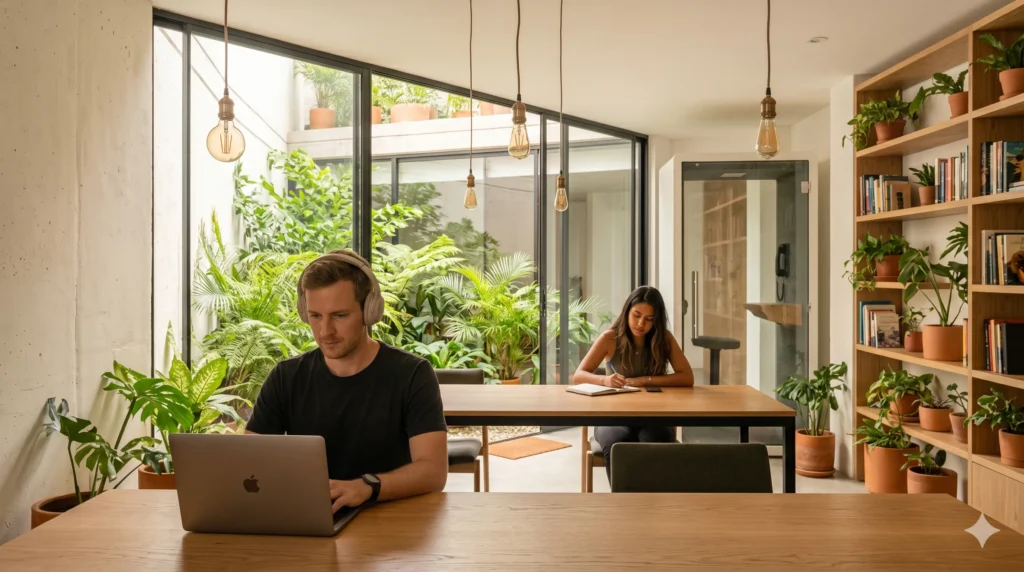
One of the most reliable indicators of a neighborhood’s nomad-friendliness is the number and quality of its workspaces. Laureles excels here. Most specialty cafés open before 8 a.m., have solid wifi, available outlets, and an implicit policy of respecting the person with a laptop.
Cafés to work from
- Pergamino Laureles: probably the best-known specialty café in Medellín. Good wifi, spacious, slightly noisy at peak hours.
- Hija Mía Café: boutique, calm aesthetic, good for non-critical calls.
- Café Revolución: multiple locations; the Laureles one is roomy and less touristy than El Poblado’s.
- Semilla Café Bar: café-restaurant hybrid, good food, good wifi.
Coworking spaces
For deep work, critical video calls, or high-focus days, a coworking still beats any café. Laureles has options: Selina (tourist-facing, central), La Joya (boutique), and coworkings inside colivings — like ours at Pranik, with private phone booths, two meeting rooms, and 24/7 access for guests.
An important point: if you will spend more than two weeks working remotely in Medellín, doing everything from cafés ends up more expensive and less productive than it sounds. A coworking day or week pass usually costs between USD 6-15 per day, and many colivings include access as part of your stay.
Where to stay: hotels, Airbnb, colivings, and long-term rentals
This is the decision that takes the most time when you first arrive in the city. There is no single right answer — it depends on how long you stay, what you are looking for, and your budget. Here is an honest mental map.
Hotels (1-7 nights)
Fine for very short stays. Downsides: no community, no kitchen, rates that do not drop much even for multiple nights. Typical range in Laureles: USD 60-140 per night.
Airbnb (1 week to 3 months)
Plentiful and can work well with a good host. The downsides no one mentions: unreliable wifi, rarely a space designed for work, isolation if you travel alone, and total cost (with fees) that ends up very close to a coliving when you actually compare. Typical range: USD 40-90 per night.
Colivings (1 month to 3+ months)
The best ratio of price, productivity, and community for digital nomads. A good coliving gives you a private room, 24/7 coworking, a ready-made community, weekly events, and rates that drop as you stay longer — ideal for a long stay in Medellín. Laureles has several: Pranik (wellness coliving with sauna, contrast therapy (ice bath), and yoga), Nomadico, Co.404, among others. Typical range: USD 45-65 per night with monthly discounts.
Long-term rentals (6+ months)
If you hold a Colombian digital nomad visa — or any 180+ day visa — renting an apartment on your own is the most economical option for long-term remote work. Furnished apartments in Laureles: 2,500,000 to 4,500,000 COP per month (USD 620-1,120). Downsides: deposits, co-signers, annual contracts, and bank paperwork.
Is Laureles safe? The honest answer
Laureles consistently ranks as one of the best-perceived comunas in Medellín for safety. That does not mean it is Tokyo. It means that, with the same common sense you would apply to any large Latin American city, you can live well. The reality: during the day you can walk virtually anywhere at any time. At night, after 10 or 11 p.m., we prefer to take a taxi or Uber for longer trips — not because of active threat, but out of practical habit.
Some concrete advice we give arriving guests: do not use your phone on the sidewalk next to major avenues, do not flash cash on the street, use Uber or Cabify at night rather than hailing a taxi (cheaper than you think), and avoid unknown zones after midnight. Laureles itself is calm. The livelier areas — Calle 70, First and Second Park — are well-trafficked until 1 or 2 a.m.
Things to do in Laureles and nearby
- First and Second Park of Laureles: the neighborhood’s social center. Bars, live music, outdoor terraces.
- Atanasio Girardot Stadium: if you like football, a Nacional or Medellín match is a must.
- Calle 70: the neighborhood’s party strip. More local than El Poblado.
- Cerro El Volador: urban hike with a 360° view of the city, twenty minutes from Laureles.
- Parque Arví and Comuna 13: reachable by metro from Estadio station.
- Yoga, sauna, and contrast therapy (ice bath): several options in the neighborhood, including Pranik’s wellness floor.
- Guatapé, San Rafael, Jardín: weekend escapes 1.5 to 3 hours away by road.
How to get around
Medellín has the best public transport system in Colombia. The metro crosses the city north to south and connects to cable cars up to the hillside comunas. From Laureles, the closest station is Estadio (line B). Uber, Cabify, DiDi, and taxis all work well and are cheap for nomads earning international salaries: USD 3-7 per ride within the city. For longer stays, renting a bike or e-scooter can be a great idea; Laureles is one of the few genuinely bikeable neighborhoods in Medellín.
Where Pranik fits in the picture
Pranik was born out of exactly this observation: Laureles has everything a digital nomad needs, but there was no space that integrated the best of modern coliving with a real wellness layer — a space for conscious travel and intentional living. A place where, walking down for breakfast, you already know five people with similar interests; where you can work from a well-equipped coworking without paying a separate membership; where the end of the day is a yoga class or a sauna and contrast therapy (ice bath) session in the same building; and where the monthly rate drops with your stay.
If you are planning 1 to 3 months in Medellín and want a landing spot that solves housing, work, community, and wellness in a single place, explore our rooms and studios. Rates from USD 45 per night, with discounts starting on your first week.
Frequently asked questions
What is the minimum recommended stay in Laureles to actually enjoy it?
One week minimum. Ideal: one month or longer. In a week you barely start to feel the rhythm of the neighborhood; in a month you form a routine, meet people, and the cost-benefit of the trip multiplies.
Do I need to speak Spanish to live in Laureles?
Not strictly required, but it helps a lot. In El Poblado you can almost get by without it; in Laureles, although more locals now speak some English, the neighborhood remains mostly Spanish-speaking. Use Google Translate the first few days and take a weekly class — it improves your experience dramatically.
Is Laureles better than El Poblado for digital nomads?
Depends on what you want. El Poblado is more international, more party-oriented, more expensive. Laureles is more local, calmer, more walkable, and cheaper. If this is your first visit and you stay one week, El Poblado may be easier. If you stay a month or more, Laureles almost always wins.
What is the best month to visit Medellín?
Medellín is called the City of Eternal Spring for a reason: weather is stable all year. Driest months are December, January, July, and August. Wettest are April, May, October, and November. August is a favorite for many nomads because of the Feria de las Flores.
Breathe. Connect. Expand. — Your next chapter starts in Laureles
Laureles is not just a location. It is a way of living Medellín with more calm, more connection, and more community. If that resonates, we would love to host you.